Hi folks! It has been a few months...... Last time I was here, I said that I was going to put this blog on hiatus for a month in order to get my online business up and running.
Well, like any new business owner, I seriously underestimated the amount of time that it would take to get even an online business up and running. Ah well......
Anyway, I'm happy to report that I have been truly enjoying my time spent in the studio and my time spent in starting a business.
I've learned so many things in the last few months. No, I won't detail them here. Where I will detail them is in my new blog! I've been told that a blog is a perfect adjunct for a business such as mine. So, if you want to follow my "meanderings" relative to crafting, jewelry, artistry, and any other thing that catches my attention, you can find my new blog at RandomDrJ.
Or check out my store at Dr J Designs.
And for now, this blog is in retirement.
Cheers!
Dr J
Monday, March 21, 2011


Monday, September 20, 2010
9-20-10 On Hiatus
The lure of business is just too strong, I guess. I am going to put this blog on hiatus for the next month while I try my hand at an on-line business.
Many of you know that in addition to being a retired executive, I am also an avid crafter. My focus of late has been jewelry. And I've discovered a nifty on-line marketplace that makes my creations available to all those interested. I've been spending a great deal of time getting things going -- and as a result, have neglected my blog.
So, rather than letting this die from neglect, I am going to put it on hiatus for the next month while I get my on-line business going.
If you would like to see my creations, please see me at
www.drjdesigns.etsy.com
Cheers!
Friday, September 17, 2010
9-17-10 Volunteering is a Good Thing
My post from earlier this week got me to thinking about volunteerism. One of the requirements for each executive at my company was to be on the board of directors for a local not-for-profit organization. I never really bucked that idea because, frankly, I thought it was a good one. It really benefits all involved.
For the company, having an executive on the board of a non-profit demonstrated commitment to the community. Yeah, I know, you are thinking, “what did it cost the company?” More than you might imagine. For example, much of the work with the non-profit happens during working hours. So the company loses that executive’s time. But in the end, it is an investment that the company is willing to make.
Of course, the non-profit (and the community) benefits because they get the free use of a seasoned executive. In addition, they automatically get the backing of an influential member of a company. And that backing often loosens the purse strings of the company, to the benefit of the non-profit.
And yes, the executive benefits as well. By participating with a non-profit, the executive expands his/her network. Typically your network will be comprised of people within your industry. However, the non-profit board is typically a mix from a variety of companies and industries. Think about how that can enrich your network.
And finally, from the executive’s point of view -- it just feels good to volunteer and participate. So even if your company doesn’t require it, consider taking some time and selecting a non-profit that fits with you and your lifestyle/personality. Then call them up and volunteer.
Cheers!
Monday, September 13, 2010
9-13-10 Need Your HELP!
Greetings readers! I won’t often use this forum to ask for anything (except for feedback from you --- I LOVE feedback and comments).
But I am going to ask for your help today (and everyday for the rest of this month). One of my colleagues is sponsoring an entry in the Pepsi Refresh Challenge. The top two vote getters in the category will be awarded $250,000 for their sponsored charitable project.
The project I am recommending will be building some badly needed softball and baseball fields in our community. When complete, the complex will provide the youth in our community a place to learn and grow in a team environment.
So now I’ll ask. Would you go vote for this project everyday, please? The link is below.
Central Plains Youth Sports voting link
We really appreciate your effort.
Cheers!
Wednesday, September 8, 2010
9-8-10 Are You A Bad Executive?
I read a blog entry today…. On BNET, by Steve Tobak about the “7 signs you may be a bad manager”. I recommend that you read the article. You can find it here.
7 Signs You May Be a Bad Manager by Steve Tobak.
Be sure to come back. I’ll wait…….
While I won’t recreate Tobak’s list here, I would like to draw a couple of parallels with the Executive Skills and Traits model that I’ve relentlessly discussed on this blog (12-30-09 Morphing to a Model).
For example, one to the signs mentioned by Tobak is that your “allies are distancing themselves from you”. One of the Communication Skills that I’ve discussed on several occasions is the need for the new/aspiring executive to create and maintain a network (1-4-10 Let's Talk). One of the members in your network should absolutely be the person you turn to for reality checks. For me, that was my executive coach. I’ve talked about this role in the past (2-8-10 Shoulda Told Me #6). Let’s face it, if you are developing into a bad executive, it isn’t happening overnight. There are indications that other people see as it is happening. So your executive coach or sounding board or whatever you choose to call it has to be the person that is willing and able to give you the figurative slap upside the head when you are being an ass.
Another sign discussed by Tobak that you are a bad manager is that “your decision-making is compromised”. Being decisive is a critical Execution Skill for the executive (1-13-10 Execution Skills -- Now go DO something!). Does every decision you make lately seem to turn into crap? And more importantly, have you been able to rationalize each bad outcome? If so, then yes, you are headed down the road of a bad executive. You need to step back and analyze your outcomes -- ask yourself some questions. What key item did I miss leading up to the decision? Did I ignore someone that I should’ve listened to? Did I not get the right people involved? And as important, you can’t let a few poor decisions freeze you from future action.
Take some time to analyze your performance, your interactions, and your organization. Get feedback. Then take action so that you aren’t one of those bad executives that everyone loves to talk about.
Cheers!
Monday, September 6, 2010
9-6-10 Labor of Love
They say that raising children is a labor of love. While I can’t attest to that, I can vouch for a similar idea….. That you should love what you do. Yes, it is called labor, but why do it (whatever your chosen profession is) if you don’t at least occasionally enjoy it?
Yes, I realize that in today’s job market, we should probably be happy that we have a job. Or if we are out of work, happy with whatever is offered to us. But the job market won’t always be that way.
And whether or not the job market comes back, the executive has a couple of responsibilities. The first is to him or herself. Have you done some analysis of your job lately? What makes you look forward to going to work? What makes you dread getting out of bed in the morning? And how can you modify your existing job to get more of the former and less of the latter? And if you can’t make the necessary modifications, are there other jobs within your company that would be less labor and more love for you? Despite the job market condition, it is always a good idea to move around in your current company than hopping from company to company.
The second responsibility of the executive is to his/her employees. It is never too late to sit down with each direct report and understand what makes them love to come to work. No, they probably won’t tell you what makes them dread coming to work. But you can certainly read between the lines and figure it out. Then it is your responsibility to work with them in creating opportunities that puts the love back into their labor. And if you can’t get rid of the things that create the dread, at least be up front with them and say so. We can all do the drudgery for a while --- if we know our bosses understand and appreciate it.
So on this Labor Day, first kick back and relax. Then when you get back to the office tomorrow, it is time to start working on how to turn labor into love.
Cheers!
Wednesday, September 1, 2010
9-1-10 100 Years of Life
My great aunt Mildred celebrated her 100th birthday a few days ago. That’s her, on the right, in the picture below. Also in the picture? Her “baby sister” and brother-in-law. Baby sister. Gives a whole new meaning to the term, eh?

Anyway, her birthday celebration got me to thinking about the change she has seen in her hundred years of life. In no particular order, here are some things that were invented in the last 100 years:
Refrigerators
Zippers (and then, of course, Velcro)
ATMs
Corn flakes
Phones (land lines, then cordless, and now cell and satellite phones)
Razors (they used to be called safety razors. Guess they ARE a lot safer than a straight razor!)
Television
Band-aids
Scotch tape (and thankfully, Post-It notes)
A-bomb
Contact lenses
Cars
Airplanes
And my favorite? Computers!
Yep, there has been a lot of change in the last 100 years. You can imagine that the executive of 100, or even 50 years ago, had a whole different set of problems and challenges to deal with. Their ability to adapt to all the change probably took on a true life or death aspect that those of us in today’s business environment can only imagine.
I guess that it doesn’t really matter what era you are from -- there will always be change. Some good, some bad. But at least you will never lack for opportunities to adapt.
Cheers!
Friday, August 27, 2010
8-27-10 On The Road Again
I admit it. I am spoiled. I realized that, yet again, yesterday. I got on an airplane yesterday, for the first time in over a year. And I realized how much having the might of a corporate travel department eases the irritations of travel.
For starters, I had to fly through Chicago. Most of you are familiar with O’Hare and the particular joys of going through one of the busiest airports in the world. And to add to the joy, I had a 3 ½ hour layover. Now it used to be, when I traveled for business, I had access to the airline’s red carpet clubs. That sure makes a lengthy layover more bearable. But yesterday, I got to spend my time sitting around in gate areas. Not exactly the best way to spend an afternoon.
My final destination was nearby Louisville, Kentucky. Arrived there about 11pm and made my way to the hotel. Which I discovered was undergoing extensive remodeling. The jackhammers, saws, and sanders started up about 8am this morning. Sigh. So I got to spend an hour or two on the phone, looking for a much quieter hotel.
So while you are still a corporate executive, learn to appreciate your travel department. While I spent my fair share of time cussing them when I was still working, I realize now just how much crap they cleared out of my way as I traveled around the world. Nothing makes you appreciate something more than not having it anymore.
Cheers!
Wednesday, August 25, 2010
8-25-10 Trust in the Service Industry
Every time we get our hair cut, we place our trust in the person with the shears. I never realized just how much trust is involved until recently.
Unfortunately, my good friend and hair stylist passed away earlier this summer. He and I had been together for well over 25 years. I realize now that he had me more than a little spoiled.
Finding a new person is no easy task. Then you have to decide what information to share -- toeing the line between dictatorial and allowing some creative license. And then of course, you have to decide when it isn’t going to work out. Only to have to start the danged process all over again.
On my first attempt to find a new person, I stayed too long and perhaps allowed too much creative license. And now have the irritating hairstyle to prove it.
The same is true of the new executive. You will be working with all sorts of service personnel in the early days of your promotion (and throughout your career). Today it will likely be your assistant. The next day it might be a graphic artist. Another day it might be a technical writer. Service personnel will be all around you. You probably won’t even have to seek them out -- they will find you.
You do have to speak up with your wants and needs. But you also have to allow the service person you are working with do their job. You can’t hamstring them with unreasonable or seemingly random dictates. Remember the delicate balance between your absolute needs and their creative abilities.
And you may find that there isn’t a good fit between you and the service person. It will be up to you to do two things. First of all, you will have to initiate the conversation about the disconnect. And second, you will have to work with the service person to come up with a way forward that works for both of you. And of course, in the extreme, you might have to replace him/her.
So give some thought to the service industries that are all around you. How are your interactions? And how can you make things better?
Cheers!
Monday, August 23, 2010
8-23-10 A Small-Town Festival
I had the opportunity to attend my hometown summer festival this past weekend. It makes me smile just to think about it. There’s nothing like a small-town festival to remind you of your roots…… But that’s another post….. Someday.
One of the events at the festival this year was bull-riding. Now, I have to admit that I don’t know a lot about bull-riding. But I also have to admit that I really enjoyed watching it in person. And yes, I know that you are wondering what in the heck this has to do with the new executive….. I’ll get to the point.
I was interested to see one of the safety measures that had been implemented in the sport. About ¾ of the bull riders wore the traditional cowboy hat. But about ¼ of them wore a helmet. Think in terms of the helmet that a catcher in baseball wears. After my initial surprise, I realized that it is a pretty darned good idea. Bull-riding is a dangerous sport. Broken arms, legs, or clavicles hurt like heck but they DO heal. A broken head? Not so much.
Yeah, you're still wondering… “so what”? Getting there……
I got to pondering why in the heck the PBRA doesn’t mandate the helmets for all riders. I mean, really, aren’t they responsible for the safety of the men that participate in the sport?
And that is where the executive comes in. In each of our industries and businesses, there are dangerous occupations. It is the responsibility of the executive in charge to ensure that 1) the proper safety procedures are in place, 2) that he/she follows those safety procedures, and 3) that his/her people follow those safety procedures.
I lead in a factory environment for several years. Two of our safety procedures were to wear safety glasses and to wear ear plugs. I never had a problem with the safety glasses. They weren’t pretty and they were often heavy, but I always wore them in the factory.
The earplugs, on the other hand, I despised. I had a hard time, when people tried to talk to me in the factory, hearing them with the ear plugs in. So I would reach up and yank them out, have my conversation, and then stuff them back into my ears before moving on -- repeating that many times during the shift. By the end of my shift, the inside of my ears would be raw from the rubbing of those dang ear plugs.
But I did it anyway. Why? Because it was my responsibility to set an example. AND, I never asked my people to do something that I wouldn’t do. So how could I get on someone for not wearing their personal protective equipment when I felt that I was exempt from it. Not the right way to do business in my opinion.
As an executive, give some thought to the relevant safety measures for your area. Then follow them. And then…… make sure that your people do as well.
Cheers!
Friday, August 20, 2010
8-20-10 Links to the Past
Continuing to re-visit comments from my survey participants……
I ran across one comment that I both agree and disagree with. Strange, but true.
When I asked my survey participants to tell me what one thing they wished they had known when they became an executive, I got this comment.
“The importance of networking. Once at the executive level, the direct links to getting tactical tasks are broken. You have to know who to go to and how to work as a team.”
Of course, we know from the Executive Skills and Traits model that networking is an important part of the communication skill set (12-30-09 Morphing to a Model and 1-4-10 Let’s Talk). So you can imagine that I agree with the importance of networking. I also agree with the idea that you have to know who to go to and also how to work as a team.
Where my survey participant and I diverge in opinion is on the idea that when you get promoted, the direct links are broken. In fact, I heartily disagree with him. My belief is that unless you royally piss off a member of your network, you never actually lose or break the link to him/her.
Yes, some members of your network might go “dormant”, for lack of a better word. That is just human nature. As we move on to new phases of our lives, there are some members of our network that we will see or talk to less frequently. The time between contacts will lengthen. And the conversation, we when do meet, can be stilted because of the lack of use. Dormancy, however, doesn’t mean the link is permanently severed.
What is does mean is that you haven’t done a good job of tending to your network. This is one task that you should deliberately schedule. Make time to call or see people that were an important part of your past. Some will think it a waste of time, but you never know what might come of this. You might pick up new ideas for a product or service. You might find that you can do your contact a favor in his/her current career stage. Or you might find that he/she is in a position to help you.
And after all, isn’t that what networks are for?
Cheers!
Tuesday, August 17, 2010
8-17-10 Discovering Limits
One of my nieces is visiting this week (love you, Kaitlyn!). She just turned 21. Ahhh to be young….. Actually, now that I think about it, not really. But it does bring back memories of discovering my limits when I was around that age.
Things like: How much autonomy do I really have from my parents? How much can I drink? How much studying do I really need to do for that test? How much can I work and still be able to go to school? At that age, there are all sorts of limits to be discovered.
As a new executive, you have a similar road to travel on discovering your limits. Of course, if you are an executive, you have already spent a fair amount of time defining and discovering the limits around your career. But as you transition to the executive payroll, there are new limits to discover.
For example, you will have to discover how much authority you actually have. Intuitively you know that you are granted additional authorities when you are promoted. The problem is…. How much? Unfortunately you will only discover the answer to this question by trial and error. Yes, you can define authority limits with your boss up front. But believe me, things change. You can make a decision one day that you believe is wholly within the limits of your authority…. Only to be chastised by your boss the next day for doing it. The limits probably didn’t shift overnight. Instead you and your boss didn’t clearly delineate all limits. Not surprising, as it would be impossible to do.
You will find many more instances of defining limits as you progress in your executive career. Fortunately, unlike the 21 year old discovering the limits of alcohol, you won’t likely face a life-threatening situation. However, you will face many career-threatening situations.
My advice? Be deliberate. Think your choices through. Don’t back away from the perceived limit. But don’t barge ahead with your head down and your senses shut off.
Cheers!
Friday, August 13, 2010
8-13-10 Don't Eat That June Bug
My dog seems to be a real aficionado of the June bugs that are plentiful here in the Midwest. The unfortunate thing about that (other than the very obvious ick factor) is that every time she eats them, she ralphs them right back up. Sigh. You would think that she would’ve learned her lesson after the first time or two. But noooo, that would be way too easy on the dog parents.
At this point, you are either really grossed out or wondering, “what in the hell does this have to do with the executive?!”. Or both.
Can’t help you with the grossed out part. But I can shed some light on what this means for the exec.
Have you ever heard the adage about the definition of insanity? Where someone keeps doing the same thing over and over -- expecting new or different results?
Well, while I can’t vouch for my dog wanting different results after eating the June bugs (altho’ I would like it), I can vouch for the fact that the executive often does the same thing over and over -- and truly expects different results.
Why do we execs do this? I think that it has to do with what worked in the past. We’ve found a process for problem-solving that has gotten us out of sticky situations before. Why not just apply it every time we get into a sticky situation?
In fact, organizations often encourage this kind of behavior. How? By sending in the same trouble-shooting team over and over. You’ve seen the routine. A program or a project falls deeper and deeper over cost or further and further behind schedule. The team in place can’t seem to turn the tide. So the senior execs put their heads together and decide to throw a tiger team at it. And who do they pick? It is always the same people. (Typically the ones that kick ass and take no prisoners -- but that’s another story.) You could write a script for what this tiger team will do, if you have watched them in action before -- because you can bet that they will do the same exact things.
Do they succeed? Sometimes, yes. Sometimes, no. Isn’t it a good thing when they do? Well, yes. Maybe.
The unfortunate thing about this approach is that the tiger team is trying to force a standard process or answer on a variety of problems.
In reality, what the executive team should be doing is putting their execution skills to use (12-30-09 Morphing to a Model and 1-3-10 Execution Skills -- Now go DO something!). You are being paid to lead your organization. In order to do this you need to analyze the situation, gather the appropriate data, synthesize the information, determine a path, and lead your team in the resolution. You have to deal with the fragmentation of the problem. You have to deal with the ambiguity inherent in the information you gather. In short, you are managing change -- often at a breakneck pace.
Because things are moving so fast or because the situation is dire, you will be tempted to trot out your “typical” solution -- one that has worked in the past. This may or may not be right. But you can be sure that it won’t be tailored to your current situation. And by following a “typical” path, you will likely end up with a less than optimal resolution.
Don’t get me wrong --- your past successes (and failures) are important. They inform your capabilities. You can use this experience as part of the data you take in during your analysis.
Just make sure that you aren’t applying the insanity rule in your day-to-day activities. Figure out what should be done in this moment --- not what you’ve done in the past.
Cheers!
Wednesday, August 11, 2010
8-11-10 Are You Strategic or Tactical?
It shouldn’t surprise you when I say that the executive is the strategist for the organization. Much has been made in the popular press (and academic press for that matter) about how the new executive has to make the shift from tactical thinker to strategic thinker when he/she is promoted into the executive ranks. One of my survey participants did a very good job in describing this move. Remember that I asked all my survey participants to tell me the one thing that they wished someone had told them when they were promoted.
This executive talked about strategic focus. “Usually new execs are promoted because they are good at tactical mgmt, but the move to exec mgmt needs to also accompany a move to longer term strategic thinking. The task of tactical mgmt is to do the best with the project that you have, but does not consider whether or not the project should be part of our business. So the shift to strategic thinking requires the new exec to ask questions about why we are in a specific business and should we stay in that business. Alternatively, the exec should ask what other businesses we might enter.”
Please don’t misunderstand. Your tactical capability is still important. There WILL be times that you have to dust off your tactical management skills and put them to use. Perhaps when a project is in trouble or when you a teaching a member of your staff how to manage a project.
But this type of tactical management should not be the whole of your job or your skills. If you will recall, one entire section of the Executive Skills and Traits model pertains to strategy (12-30-09 Morphing to a Model and 1-8-10 I Have A Dream). The vision skills are definitely important.
The hard part comes from trying to discover your own vision skills and then putting them to use. Why? We are creatures of habit. And as my survey participant indicated, the executive is usually promoted because he/she is really good at tactical management. It is much easier to stick with what we know and are comfortable with. Tactical management is a concrete, “get your arms around it” kind of management tactic. You know how it works and you know what to expect at the end.
Strategic management, on the other hand, is one of the mushy, “don’t know what the hell I’m doing” kind of processes. In strategic management, you are asking the questions that don’t have one right answer. Or may not even HAVE an answer. You are plotting courses for a destination that only you might be able to see -- or you only have a vague idea that it even exists. You are realizing that the questions you used to ask will have no relevance in a strategic discussion. This same is often true for the data you used to gather in order to make a tactical decision -- often it won’t do much to enlighten you for a strategic decision.
In short, strategic management is hard work. But you have to do it. Because if you don’t, who will be charting the course for the next 3 to 5 to 10 years in your organization? If you abdicate this responsibility, you are leaving the future life of the organization to the whims of the marketplace. This is because your default strategy will be to react to whatever stumbles across your desk or field of vision. You won’t filter out the unimportant. And by reacting to anything, you will likely miss the most subtle, but often most important, impacts to your organization.
So suck it up and hone your strategy skills -- for your sake and for the sake of the people that depend on you.
Cheers!
Monday, August 9, 2010
8-9-10 The Decider
Most executives don’t consider their job title to be “The Decider”. And that is a mistake. Why? Because most executives would tell you, if you asked how decisions are made in their company, that it is a group effort. Remember, the model for Executive Skills and Traits defines decisiveness as one of the important execution skills that an executive will need (12-30-09 Morphing to a Model and 1-13-10 Execution Skills -- Now go DO something!).
One of my survey participants had an interesting take on the whole “decider” role that the executive should play. He said,
“Effectiveness at being a leader can by crystallized on those big-deal moments: the pitch is over, the options are up there, sides are drawn. Everyone is looking at the decision-maker -- ‘the decider‘.”
Yes, I know. In the past I have talked about the need for the executive to “spread around” the decision-making. I’m not backing away from that. As an executive, you have to know what level is the appropriate level for making a decision. Many times that level will be one of your staff members.
There are times, however, when YOU will be the decision maker. That is what my survey participant was talking about. You have to take the information that you have, check your gut, take a deep breath, and make the damn decision.
It is interesting how many times that I’ve seen an executive actually back away from one of those big-deal moments. Perhaps they do this by delegating a decision that should not be. Or they “make a decision” by not actually deciding anything (putting their avoidance technique to work). Or they let the group make the decision. Or they kick it upstairs to be made.
Whatever the method, by backing away, the executive becomes less effective. Not only for the current decision, but also for future ones. If your boss or peers or staff watched you back away from one big-deal moment, how likely are they to come back to you the next time? Why bother, if you can’t make a decision!?
So remember, as an executive you ARE expected to make decisions. Step up. You can do it.
Cheers!
Wednesday, August 4, 2010
8-4-10 Scrambling is Good
I played in a golf tournament this evening…. A scramble format. For those of you that aren’t familiar with the game or the format, a scramble is a great thing. In this format, each person on the team hits their own ball then you decide which is the best shot, then everyone hits from that spot. Continuing on that way, picking the best shot, until the ball is in the hole. For hackers like me, it is about the only way we can ever consistently get a good score.
It occurred to me that the scramble format is a good metaphor for how we accomplish things at work. As an executive, it is up to you to set up an effective team. Once you have the team in place, you are relying on each of them to take their best shot on any given project. Since you most often have a team working on a project, some of the team members’ shots will be better than others. And that’s okay.
Because if you “play” the scramble format, you can pick the best “shots” and the whole team can proceed from there.
Yes, some would say that this is an inefficient way to do business -- simply because you have more than one person working on a project step. I would suggest that any waste you have from some overlap is more than offset by the longer strides you will be able to make by selecting the best from each person.
So as you launch that next project with your team, consider using the scramble format -- and see how much further and faster your team goes.
Cheers!
Monday, August 2, 2010
8-2-10 Visibility
I never gave much thought to visibility…. Until re-reading some of the comments and input from my research survey. If you remember, I asked each participant to tell me the one thing that they wish they had known when they became an executive. Here’s what one research participant had to say…..
“New executives must be particularly visible so the stakeholders can satisfy their curiosity on whether or not the new executive was the right choice for the job, and whether or not he or she can be trusted.”
Interesting twist on visibility, isn’t it? Frankly, whenever I’d thought about visibility in the past, it was way more self-centered….. As in, wanting to get positive visibility with my boss or potential bosses so that my career would advance.
However, this twist on visibility acknowledges the need that the people around you have. And it makes sense. When you are first promoted to the executive ranks, many people will know you and your past. However, they don’t know how you will operate as an executive. Additionally, there are many more people that don’t know you at all --- and want to understand how you will operate.
Whether they know you already or not, people are interested (and even worried) about how you operate and what impact it will have on them.
The concept actually touches on a couple of aspects in the Executive Skills and Traits Model (12-30-09 Morphing to a Model). Within the model, there is a set of skills labeled Communication Skills (1-4-10 Let's Talk). And while the idea of visibility doesn’t fit nicely within those individual skills, what is visibility if not some form of communication?
And you will note that my survey participant addressed the need for people learn about the new executive’s trustworthiness. If you look in the Executive Traits section of the model, you will find a set of traits called Honest, Ethical, and Credible (1-18-10 Executive Traits). Certainly, those who promoted you have already made this judgment as to your trustworthiness. But many more people will still need to see you, interact with you, and make their own judgment.
So remember, as you go about your day, people are looking for you. Quite literally. So that they can learn about you, what makes you tick, and how you will impact their lives.
Cheers!
Friday, July 30, 2010
7-30-10 Loose Lips
The latest news about the leaking of sensitive information within the Army got me to thinking……
Have you ever heard the phrase, “loose lips sink ships”? The phrase was actually created as a slogan during World War II by the US Office of War Information. It was part of an ongoing effort to warn people about inadvertently giving useful information to enemy spies.
This is how it looked back then……
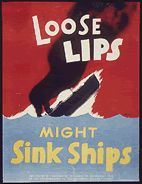
Since I worked for a military contractor for many years, I am very familiar with the need to protect the data within your company, project, etc. And it was drilled into us, over and over again, that ANY conversation we had outside of the office could potentially be overheard. And used to the detriment of our customer. So I “grew up” in business being well aware of the need to protect information.
In today’s environment that is even more important. Not only for military contractors but for commercial business as well. You think I’m kidding -- relative to the commercial business? Nope, I’m not. Think about how valuable the information you carry around is. For example, wouldn’t your competitors like to know that you are planning to compete on “x” contract? Or wouldn’t your customers like to know that you are working on a new product -- one that will obsolete the product that they are preparing to spend millions on?
Your competitors (and others) are constantly on the lookout for information that will give them an advantage over your business. Most firms don’t resort to industrial espionage -- mostly because they don’t have to. All they have to do is to hang out in the places that you and your staff frequent. Think about it. How many lunch-time conversations have you had about sensitive business with your colleagues? And did you know who sat at the tables next to you? What information did you and your colleagues inadvertently give away?
Of course, I’m not suggesting that you succumb to paranoia. Only that it is prudent for any executive to remember how valuable the information they carry around in their head truly is.
Cheers!
Have you ever heard the phrase, “loose lips sink ships”? The phrase was actually created as a slogan during World War II by the US Office of War Information. It was part of an ongoing effort to warn people about inadvertently giving useful information to enemy spies.
This is how it looked back then……
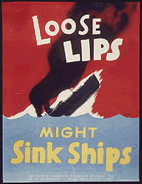
Since I worked for a military contractor for many years, I am very familiar with the need to protect the data within your company, project, etc. And it was drilled into us, over and over again, that ANY conversation we had outside of the office could potentially be overheard. And used to the detriment of our customer. So I “grew up” in business being well aware of the need to protect information.
In today’s environment that is even more important. Not only for military contractors but for commercial business as well. You think I’m kidding -- relative to the commercial business? Nope, I’m not. Think about how valuable the information you carry around is. For example, wouldn’t your competitors like to know that you are planning to compete on “x” contract? Or wouldn’t your customers like to know that you are working on a new product -- one that will obsolete the product that they are preparing to spend millions on?
Your competitors (and others) are constantly on the lookout for information that will give them an advantage over your business. Most firms don’t resort to industrial espionage -- mostly because they don’t have to. All they have to do is to hang out in the places that you and your staff frequent. Think about it. How many lunch-time conversations have you had about sensitive business with your colleagues? And did you know who sat at the tables next to you? What information did you and your colleagues inadvertently give away?
Of course, I’m not suggesting that you succumb to paranoia. Only that it is prudent for any executive to remember how valuable the information they carry around in their head truly is.
Cheers!
Wednesday, July 28, 2010
7-28-10 Is It Better To Beg Forgiveness?
Here’s an interesting question….. Is it better to beg forgiveness or to ask permission? Hmmmmm…..
Guess that depends on the situation, of course. But in the business world, I learned early on that it is better to take action and then beg forgiveness if something goes awry.
Oh sure, there are times that it is absolutely mandatory that you ask permission. Like when you are about to commit the company to a multi-billion dollar contract, well then, you should probably ask a couple of people if it is okay. There is a line here that you must not cross…. And that line will vary depending on your boss of the moment, your situation, your company, etc.
But, for most of the day-to-day business activities, I never really had much luck with asking permission. It gives people the opportunity to delay your actions -- even when their agreement wasn’t really needed. It also gives people the opportunity to torpedo your actions -- if it is something they don’t want. Or, heaven forbid, it gives someone the opportunity to say no. And if that someone is your boss, you can consider the door to be firmly shut to your idea. No amount of finagling will get you back to yes.
My policy is to assume that I have the authority (and responsibility) to do something until someone (usually my boss) tells me different. Have I screwed up with that attitude? Occasionally, yes. Hence the idea of begging forgiveness. It is real easy to say, “I’m sorry, but I thought that was my responsibility. I’ll not do that again”.
Interestingly, people (my boss, specifically) have always been willing to accept that and we move on.
Here’s something even more interesting. I’ve gotten feedback in the past that I was rated highly in evaluations because of my willingness to take the initiative, make a decision, and implement a plan. If I hadn’t assumed the appropriate authority, that would have never happened.
So remember, you are an executive. And you are in charge. Act like it.
Cheers!
Monday, July 26, 2010
7-26-10 So Many Bosses, So Little Time
For whatever reason, today I was pondering the various types of bosses out there. Of course, there are as many types of bosses as there are people holding the position. But a few types come to mind for me……
The Hit and Run. This boss never seems to have enough time to do anything properly. He runs into your office, drops a new assignment on you (like a hand grenade), and then breezes out before the explosion. Or he arrives at a meeting 10 minutes late, spends everyone else’s time getting caught up to speed, and then leaves early --- before any decisions can be made. Of course, his buy-in is required, so the decision is delayed to another day. Or with performance reviews --- you can count on them to be scheduled and re-scheduled, multiple times, because he always seems to have more important things to do.
The Psycho. With this boss, you never know which boss will actually show up. Think Mel Gibson in his current state --- you know, the psycho that keeps ranting and raving on those recorded phone calls. One day, this boss is as nice as can be. And then the next? Well, when you recognize the signals, you learn to stay out of his way during those times. ‘Cause lets face it, when he is in psycho mode, you cannot do anything right or to his satisfaction.
The Good Ol’ Boy. Also known as The Politician. This guy is everyone’s friend. And all too often, he will say exactly what you want to hear -- and not what you need to hear. He knows everyone’s business, and doesn’t hesitate to insert himself into it, but only if he can be the hero.
The No Questions Answered. You know the type --- “because I’m the boss, that’s why”. Oh sure, he’ll never say that out loud, but you know that is what he means. Don’t bother asking questions, because he won’t answer them or will duck you when he sees you coming. Or if he does deign to answer the question, he’ll be sure to make you feel like a fool for asking.
The Figurehead. This guy generally doesn’t have a clue. He IS the boss, but to get anything done, you have to figure out who is really in charge and go to that person.
And on a side note….. Yes, I put these in terms of “he or him”. But that doesn’t mean we women are exempt from these types. It happens with either gender.
And while I’m on a side note, yes I recognize that I’ve just written about all the negative boss types. Oh sure, I know that there are good ones out there. But really, would that be as interesting to read about?!
Why is it important to recognize the different types of bosses? First, you need to know who you work for and how to handle their idiosyncrasies. Because we all “manage” upwards with our boss. And knowing the type of boss you have will make your upward management strategies more efficient.
Second, you need to understand what kind of boss you are. If you are one of these negative types, KNOCK IT OFF. Seriously, you’ve probably worked for one of these folks in your career. Didn’t you just hate it? So, if you ARE one of these types, don’t you suppose that you make life way to difficult for those people that work for you?
Cheers!
Subscribe to:
Posts (Atom)

 Posts


